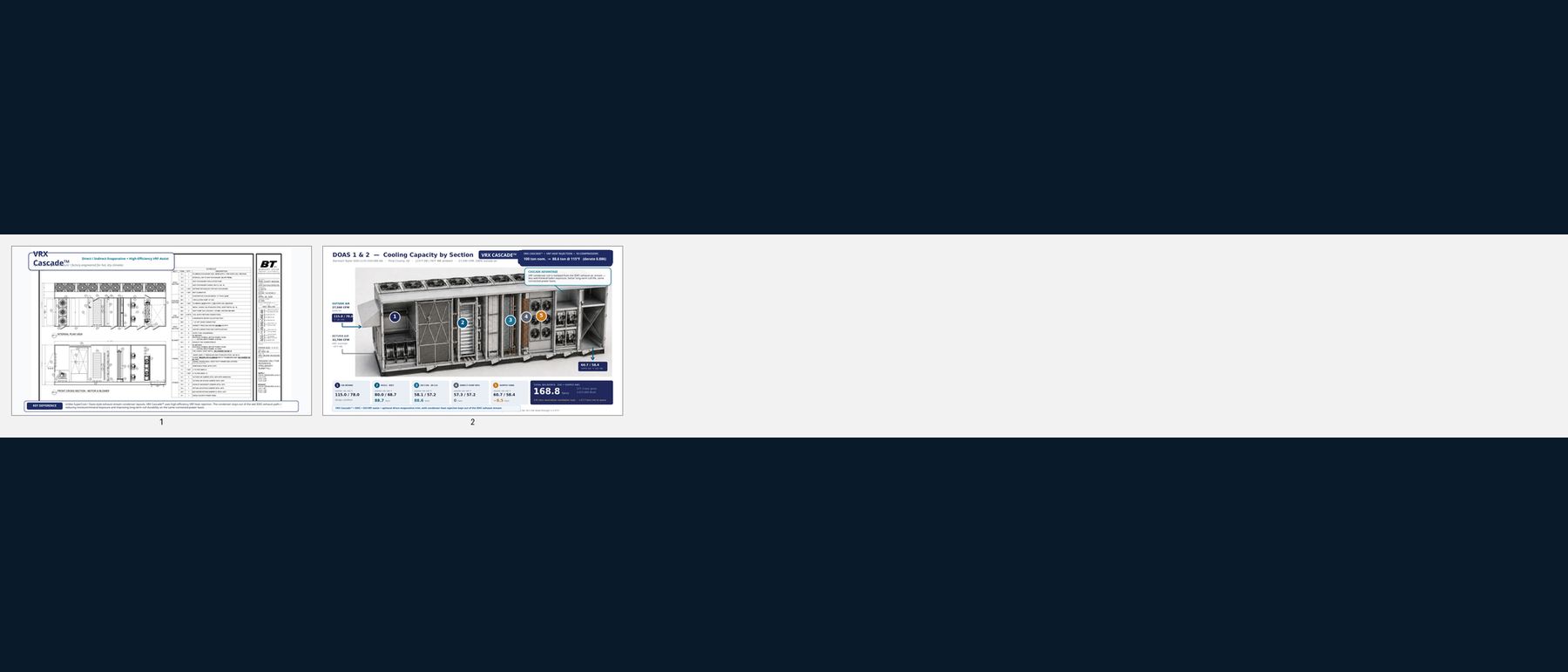
VRX Technologies
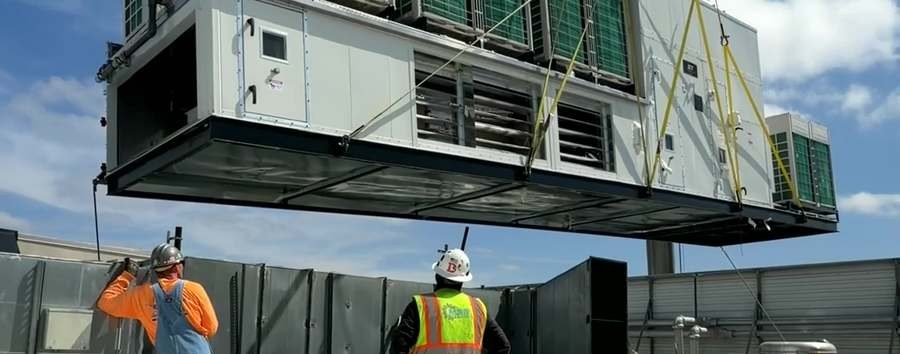
Packaged rooftop air handling unit being lifted into place by crane during installation

VRX Cascade · Dedicated Outdoor Air

Let the dry air do the work.

Cascade conditions 100% outside air in the hottest, driest climates on the map — and needs dramatically less mechanical cooling to get there. Engineered for large‑scale DOAS and data center outside‑air loads.

Follow the air: 115°F → 80°F → 58.1°F → 57.3°F → 60.7°F. The final rise is fan heat. Illustrated full-assist Pinal County design point; performance depends on operating conditions.
100%
Outside air, no return
115°F
Design conditions handled
32–44%
Less mechanical cooling at design
Zero
Electric reheat coils

01 / The problem

Outside air is the hardest air on the site.

A dedicated outdoor air system has nowhere to hide. There is no return air to blend with, no mild starting point — every cubic foot arrives at whatever the desert is doing that afternoon, and it all has to leave dry and neutral.

The conventional answer is to size a large refrigeration plant against the worst hour of the year and then run it hard. You buy tonnage you use a handful of days, you buy the electrical service to feed it, and you pay for both every month for twenty years.

Cascade starts somewhere else: in a hot, dry climate, most of the cooling you need is already available in the air itself.
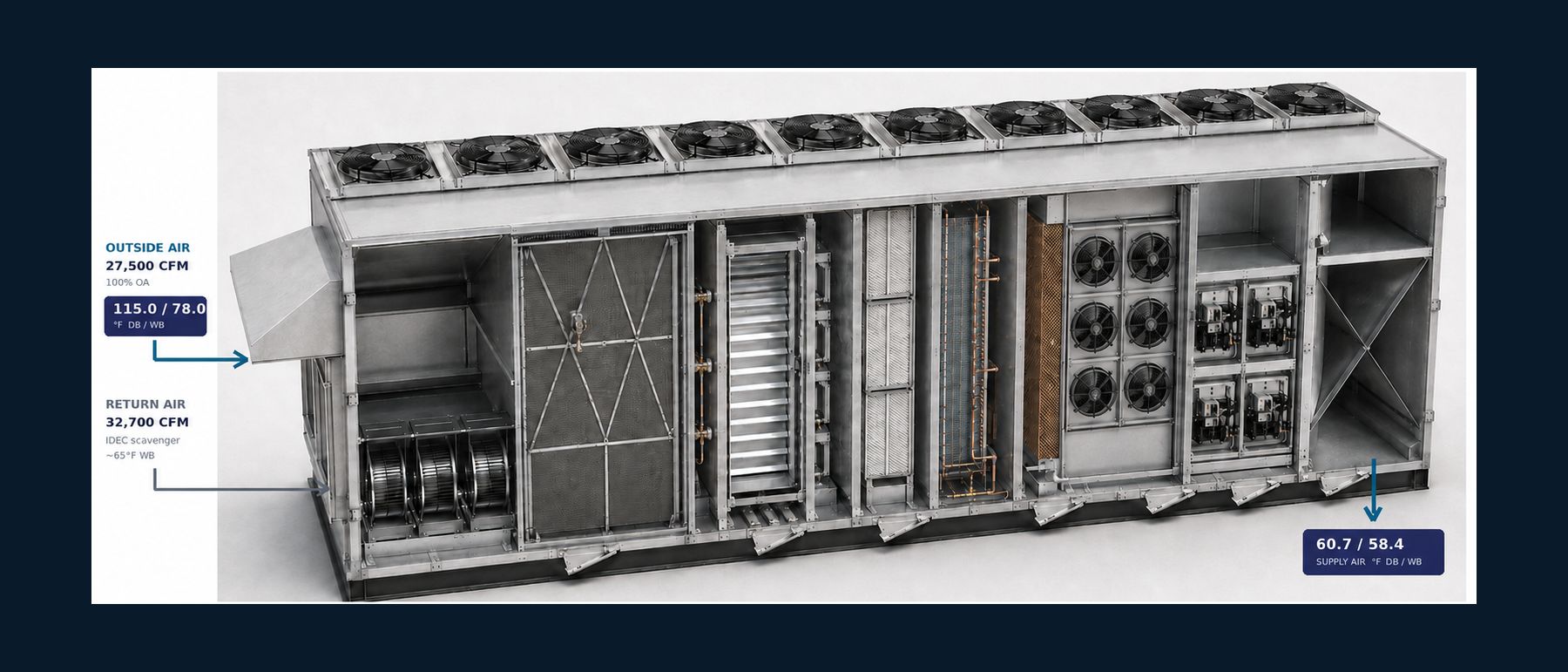
Cutaway rendering of a dedicated outdoor air unit showing each conditioning section
Outside air, section by section — rendering
02 / What lands in the space

Dry, neutral air that stays dry.

Cascade is controlled to a moisture target, not a thermostat reading. That distinction matters more than it sounds: relative humidity drifts with temperature, so a system tuned to a percentage can hold its setpoint on paper while the actual moisture in the space moves several degrees of dew point.

Holding moisture directly means the air delivered to the zones is consistent hour to hour and season to season — which is what a lab, a clean space, a computer room or a large occupied building actually needs from its outside air.

Air handled100% outside air
Control basisMoisture, not space RH
Supply conditionDry and neutral
ClimateHot and dry, to 115°F

Cascade is factory‑engineered per project. Capacities, staging and supply conditions are selected against your design day, elevation and airflow — not taken from a catalog line.

03 / Connected load

A third to nearly half less mechanical cooling.

Less refrigeration tonnage at design is not just an energy story. It is a smaller compressor plant to buy, a smaller electrical service to feed it, less switchgear, less roof, and a lighter bill every month it runs.

Equipment

Smaller plant

Tonnage you do not install is tonnage you never buy, rig, commission or service.

Electrical

Lighter service

Less connected load to find, feed and pay a demand charge on for the life of the building.

Operating

Lower run cost

The hours the compressors do not have to run are the cheapest hours the system will ever have.

Range reflects design‑condition analysis at 115°F. Project‑specific — we run it against your climate file, elevation and airflow before anyone puts a number in a spec.

04 / Service life

Coils that do not live in wet air.

Hybrid systems that park the condenser in the wet exhaust stream buy a little performance and pay for it in maintenance. Moisture and minerals go where that air goes, year after year, and the coil is the thing that wears.

Cascade keeps heat rejection out of that path. Same connected‑power basis, materially less exposure — which shows up as coil life, cleaning intervals and the condition of the unit in year ten rather than as a number on a submittal.

Condenser exposureOut of the wet stream
Mineral and moisture loadMaterially reduced
Connected power basisUnchanged
Where it shows upYear 10, not day 1

05 / Reheat

No electric reheat coil on the schedule.

Dehumidifying air and then reheating it with resistance is one of the most expensive things a building can do, and it is the line energy‑code reviewers look for first. Cascade delivers its supply condition without an electric reheat coil — so the conversation with the reviewer starts in a better place, and the operating cost never appears at all.

The energy you never spend needs no justification, no exception request and no offset elsewhere in the design.

Rendering of the Cascade dedicated outdoor air platform
No electric reheat coil on the schedule — rendering

06 / Where it fits

Two very different rooms, one outside-air problem.

Large-scale DOAS

Buildings that need a lot of outside air

Laboratories, healthcare, education, manufacturing and large occupied buildings — anywhere ventilation rates are high, the climate is punishing, and the mechanical room and electrical service are already spoken for.

High ventilation · Constrained service
Data centers

Outside-air loads on a constrained site

Data center campuses carry real outside‑air requirements alongside the IT load, and they carry them in exactly the hot, dry, water‑scarce places where conventional approaches cost the most to run.

Works alongside HydroCore

07 / Written for the reviewer

Selected on your numbers, not ours.

Cascade is engineered to order. Before it reaches a spec, we run the selection against your design day, elevation, airflow and ventilation rate, and hand your design team the analysis in the form they have to defend it in.

We will not tell you a product is code‑compliant. Adoption, amendments and local enforcement vary, and every project needs its own engineering validation and authority review.

Energy‑code pathway analysis90.1 / T24
Engineering submittal supportSpec‑ready
Psychrometric basisYour design day
Cost and O&M modeling10‑yr lifecycle

Send us the worst hour of your design year.

Design conditions, airflow, ventilation rate, elevation. We will tell you what Cascade does with it — and what the mechanical plant and electrical service look like on the other side.