VRX DewCycle · Automated Heat Exchanger Cleaning
In dusty environments, air‑cooled coils foul fast and take capacity and efficiency with them. DewCycle cleans them on condition — with no crew, no hoses, no added water, and no interruption to cooling.
01 / The problem
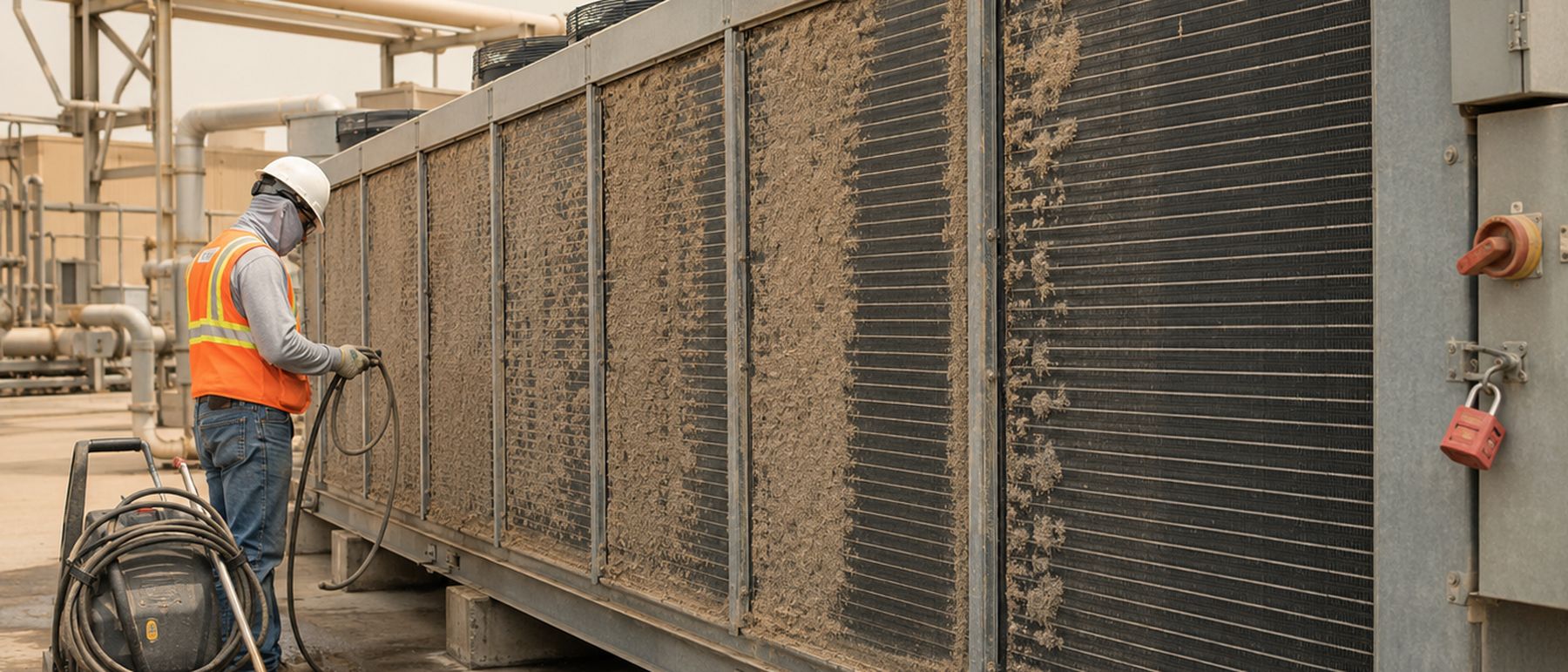
On a dusty site, an air‑cooled coil starts losing performance the day it is commissioned. Capacity drifts down, energy drifts up, and nothing on the dashboard says so until the plant is working noticeably harder than it should.
The conventional answer is a crew with hoses on a fixed schedule — which is wrong at both ends. Wash too early and you paid for labor and isolation you did not need. Wash too late and the plant ran degraded for months before anyone noticed. Either way a unit comes offline to do it.
Calendar maintenance is a guess about a condition nobody measured.
02 / What happens instead
DewCycle cleans a single unit at a time, and only when the fleet has the capacity to spare. The remaining units carry the full load throughout, so the building or the data hall never sees it happen.
No truck roll, no work order, no isolation valve, and no window negotiated with operations. Cleaning stops being an event you schedule around and becomes something the plant does on its own.
03 / What it does not need
DewCycle needs no spray hardware, no external water supply, no chemicals and no additional equipment on the skid. That matters most in exactly the places fouling is worst — arid, dusty sites where water is scarce, expensive, or politically difficult to ask for.
No makeup water, no supply line to run, nothing added to the site water budget.
No nozzles, pumps or piping to buy, commission, winterize or maintain.
No chemicals to store, deliver, handle or dispose of, and no discharge to account for.
04 / Proof, not faith
DewCycle records performance before and after each cycle and trends it per unit over time. You do not have to take anyone’s word that the coil is clean — including ours.
That record does two useful things. It shows the cleaning is working, unit by unit. And when a coil stops responding the way it used to, it says so — which is the moment a human should actually be dispatched, instead of on a date chosen a year in advance.
05 / What it is worth
The standing maintenance line for manual coil washing, and the isolation time that comes with it.
A coil kept near its design condition does not quietly cost you efficiency between service visits.
Cleaning that never takes capacity offline is cleaning that never argues with an availability commitment.
Trend data that supports water‑use, sustainability and uptime reporting with measurements rather than assertions.
06 / Where it matters most
Inland valleys, desert sites and agricultural corridors, where airborne dust makes fouling a monthly problem rather than an annual one.
Facilities where taking a unit out of service to wash a coil is a conversation nobody wants to have with operations.
Plants where sending a crew is expensive, slow, or simply does not happen as often as the maintenance plan claims.
07 / Patent pending
DewCycle is the subject of a United States patent application. What it delivers — verified, automated coil cleaning with no added water and no loss of cooling — is what this page can usefully tell you.
How the system decides when a unit is eligible, how it protects the load while a unit is out of the rotation, and how it confirms the cleaning worked are the parts we walk your engineering and operations teams through directly.
Performance is project‑specific and depends on site conditions, dust loading and fleet configuration. We model it against your site before anyone commits a number to a specification.
Send us the site, the dust conditions and what coil maintenance costs you today in labor and lost capacity. We will show you what it looks like when the plant handles it itself.