OR 01
Orthopedic
68°FTemperature
40%Relative humidity
VRX CriticalZone™ — OR Series
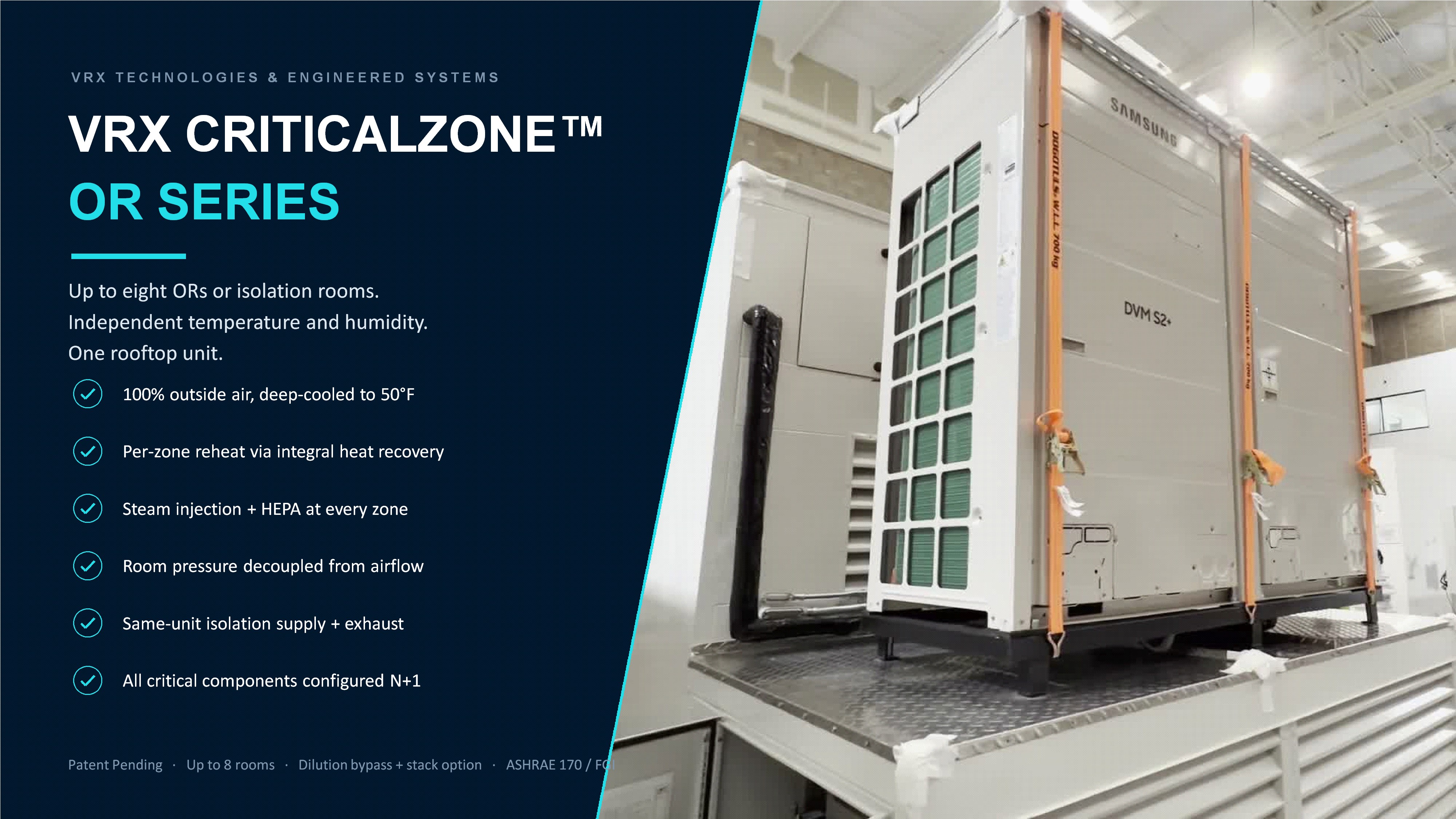
VRX CriticalZone™ OR Series is a rooftop air-handling system for operating rooms and isolation rooms. It independently controls temperature, humidity, and room pressure in up to eight rooms—from one coordinated platform.
Different rooms should not have to settle for the same conditions. CriticalZone brings individual room control, 100% outside air, and critical-component redundancy together.
CriticalZone OR Series presentation
Up to eight operating rooms or isolation rooms, with independent temperature, humidity, and room-pressure control.
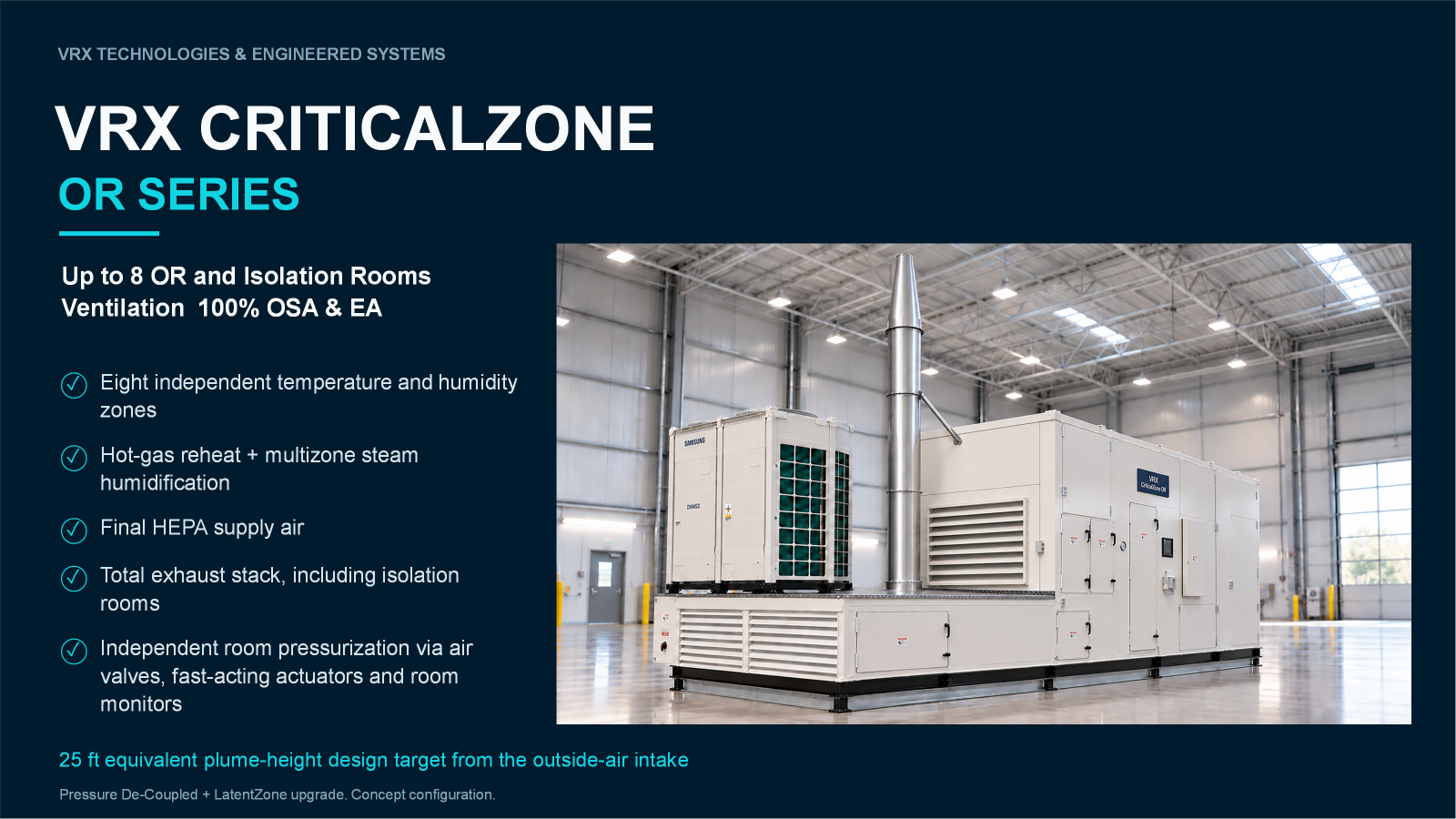
Exhaust design target: 25 ft equivalent plume height from the outside-air intake. Final exhaust selection determines plume performance.
01 / Independent by zone
An orthopedic OR and a cardiac OR may both call for 68°F, while requiring different humidity settings. A nearby isolation room may need another temperature and a different pressure relationship. CriticalZone is designed around those differences.
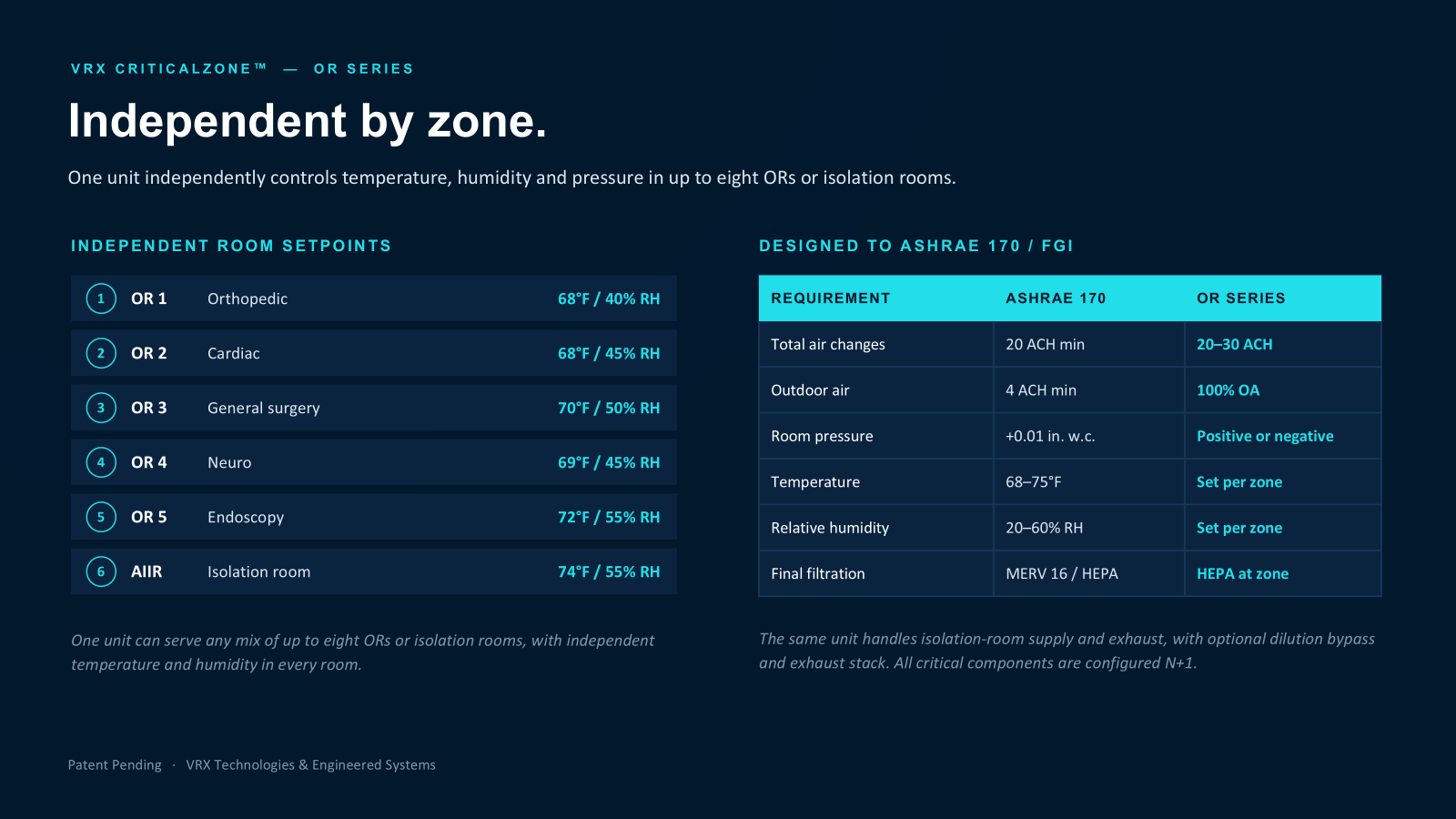
One unit can serve any mix of up to eight operating rooms or isolation rooms, with independent temperature, humidity, and pressure control. The six-room example below makes that independence tangible.
OR 01
68°FTemperature
40%Relative humidity
OR 02
68°FTemperature
45%Relative humidity
OR 03
70°FTemperature
50%Relative humidity
OR 04
69°FTemperature
45%Relative humidity
OR 05
72°FTemperature
55%Relative humidity
AIIR
74°FTemperature
55%Relative humidity
Illustrative settings from the VRX presentation, not clinical setpoint recommendations. Actual room conditions are established for the facility and project.
Which rooms in your facility need different conditions—and how well does your current system accommodate them?
02 / What the platform brings together
Outside air, temperature, moisture, filtration, and pressure all influence a critical room’s environment. CriticalZone brings these functions into one rooftop platform while preserving control at each zone.
The outside-air supply is deep-cooled to 50°F, then each zone uses hot-gas reheat from integral heat recovery to reach its own temperature setting. Multizone steam injection follows reheat for humidity control, with final HEPA filtration at every zone. This gives the conversation a clear focus: the conditions each room needs, within one coordinated system.
Could one coordinated rooftop system support the different conditions your rooms need?
03 / Built around critical-space priorities
CriticalZone decouples room-pressure control from airflow and supports positive or negative pressure relationships using air valves, fast-acting actuators, and room monitors. The selected room use determines the required relationship; the platform brings pressure into the same room-by-room control conversation as temperature and humidity.
The same unit handles isolation-room supply and exhaust. The total exhaust stack includes isolation rooms, allowing the project team to consider the supply and exhaust needs together when evaluating an isolation-room application.
All critical components are configured N+1: an additional component beyond the number required for the design duty. Discuss the selected components and operating sequence with VRX to understand how the redundancy strategy fits your facility’s continuity priorities.
04 / Start with your facility
Planning an operating suite, evaluating isolation-room capacity, or replacing equipment that serves critical spaces? Tell us what must be controlled independently—and what makes the existing approach difficult.
Start with the number and type of rooms, the conditions that must vary from room to room, and your supply, exhaust, and redundancy priorities. VRX can help your team evaluate how CriticalZone OR could fit the project and its applicable ASHRAE 170 / FGI requirements.
Patent pending. Platform features and room examples are based on the VRX CriticalZone slides in the main presentation. Final room conditions, airflow, filtration, redundancy, and applicable facility requirements must be confirmed for the selected project configuration.
Let’s discuss your operating-room or isolation-room project.