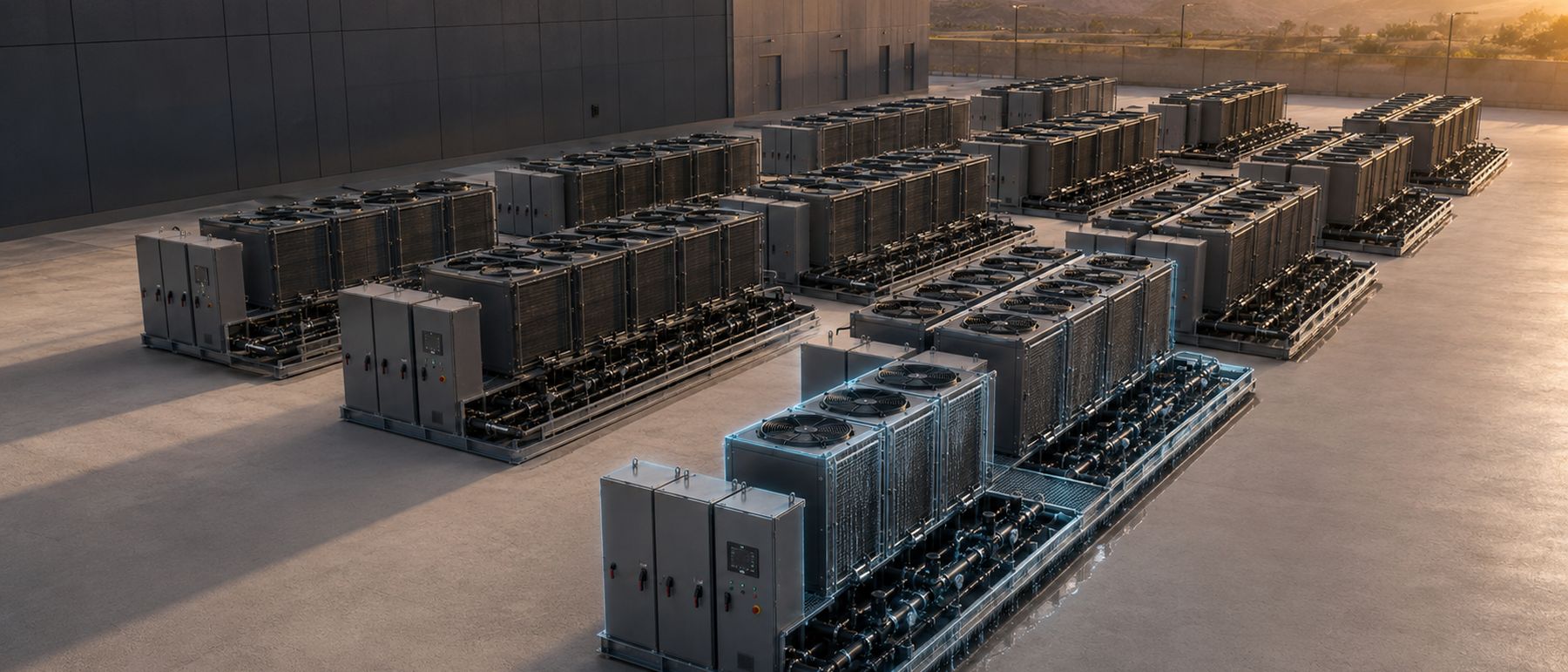
HydroCore · Data Center Cooling Platform
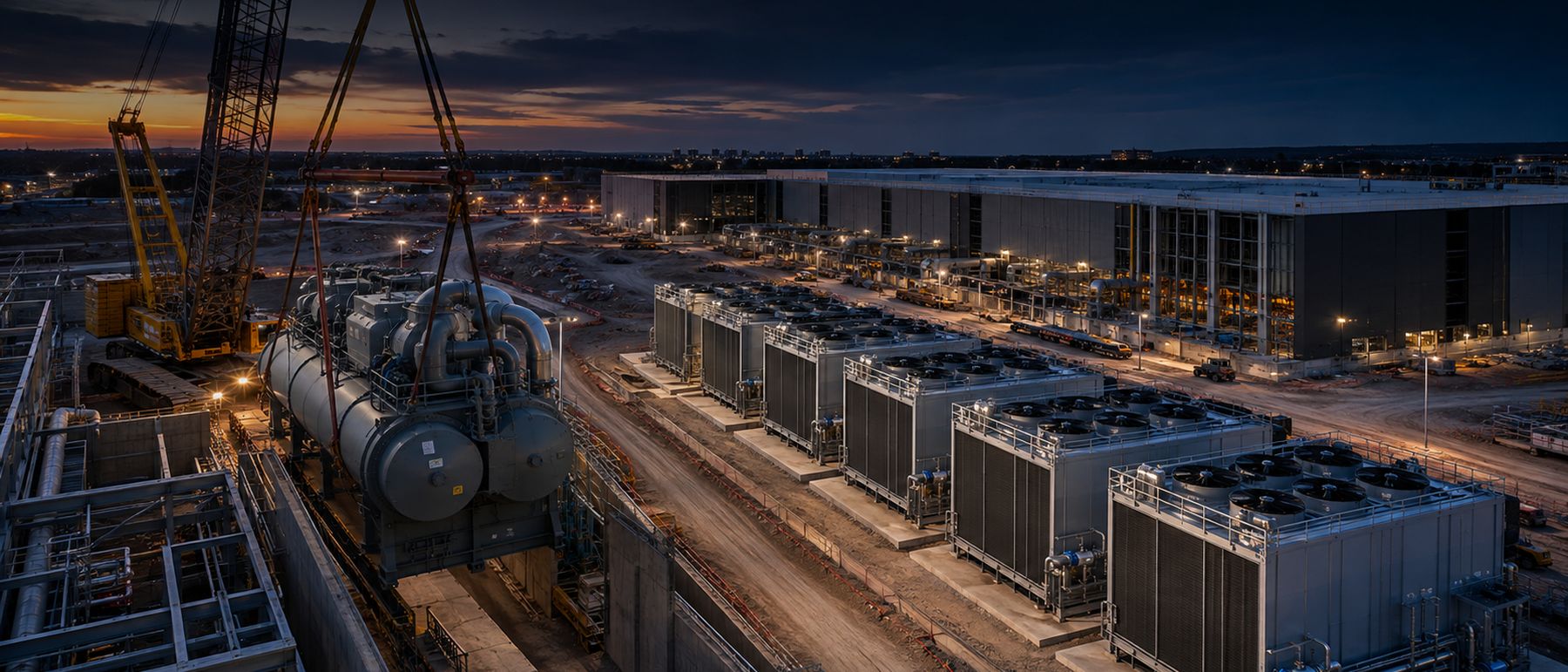
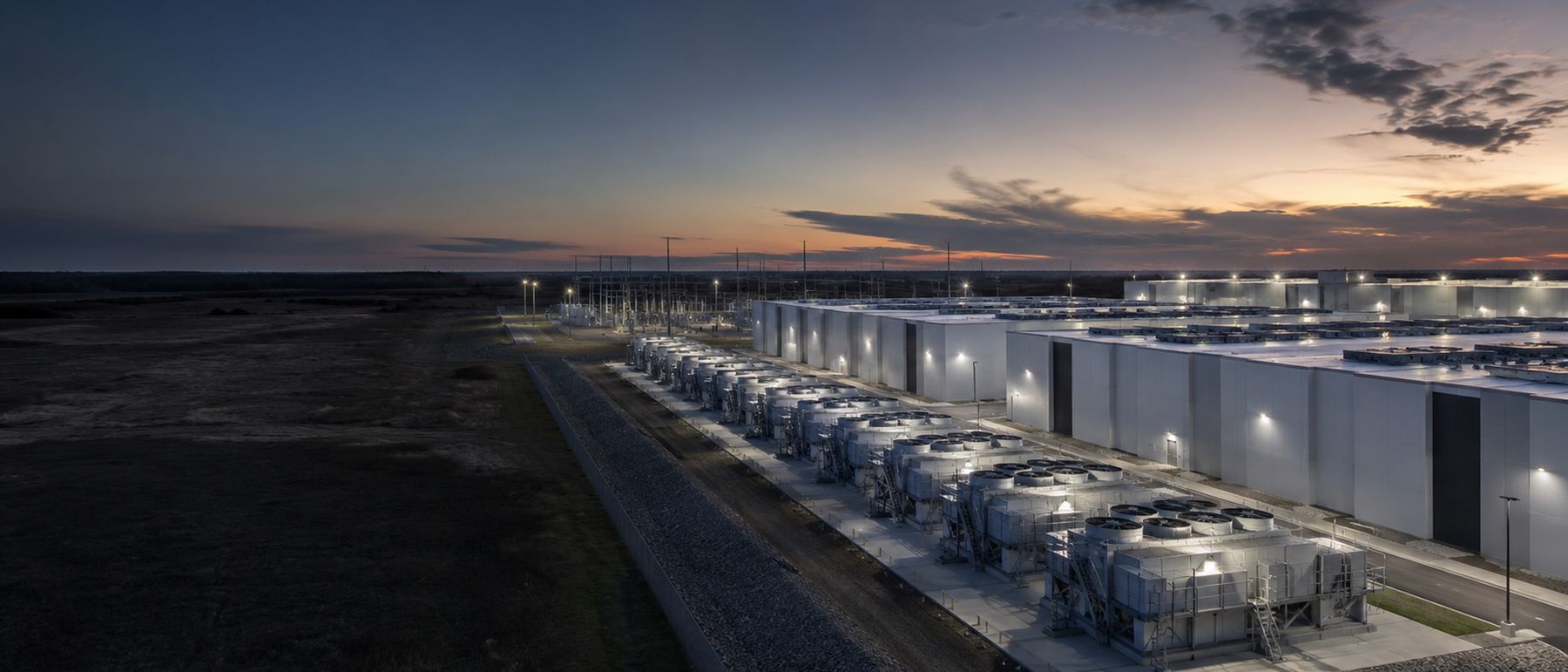
Water, community acceptance, capital timing and execution speed are what stall data center projects — not tonnage. HydroCore is a modular 300‑ton cooling platform engineered against all four.
01 / The constraint stack
Every stalled project we see is stuck on the same short list. HydroCore was designed backwards from it — start with what blocks approval and funding, then build the cooling around it.
Capacity, interconnection and the schedule the utility actually controls.
Consumption, noise and the permit test a neighborhood applies.
How much mechanical spend is committed before revenue arrives.
Lead times, staging resolution and speed to first energized load.
02 / Water
A conventional evaporative plant draws water every hour it runs, whether the day calls for it or not. HydroCore rejects heat dry as its baseline. Adiabatic assist is an option you switch on — so the trade between power draw and water draw becomes a decision you make for the site, not a condition you inherit with the plant.
With assist enabled on a 20 MW campus, roughly 115–120 million gallons a year never gets drawn.
Where water is the binding constraint, run drier. Where power is tight and water is available, lean on the assist. It changes what you can tell a water district — and it changes which sites stay on the list.
Basis: 20 MW / 6,000 tons, continuous tower makeup compared with peak‑only assist operation. Project‑specific — we model it against your climate file and load profile.
03 / Energy performance
A conventional waterside economizer buys you free-cooling hours and charges you for them — another heat exchanger, more piping, more valves, and pressure drop your pumps pay for every hour of the year, including the hours the economizer does nothing.
HydroCore reaches economizer-level energy performance through integrated low-lift compressor operation instead. The equipment simply is not there to buy, install, commission, maintain or pump through.
No separate economizer heat exchanger, bypass piping or changeover valve package to purchase and install.
Nothing extra sitting in the hydronic loop for your pumps to push against, year‑round.
Every component removed from the design is a component that never needs maintenance, spares or a technician.
Less field assembly and fewer trades on the critical path between groundbreaking and first energized load.
The cheapest, quietest and most reliable piece of equipment on any project is the one you did not have to install.
04 / Community acceptance
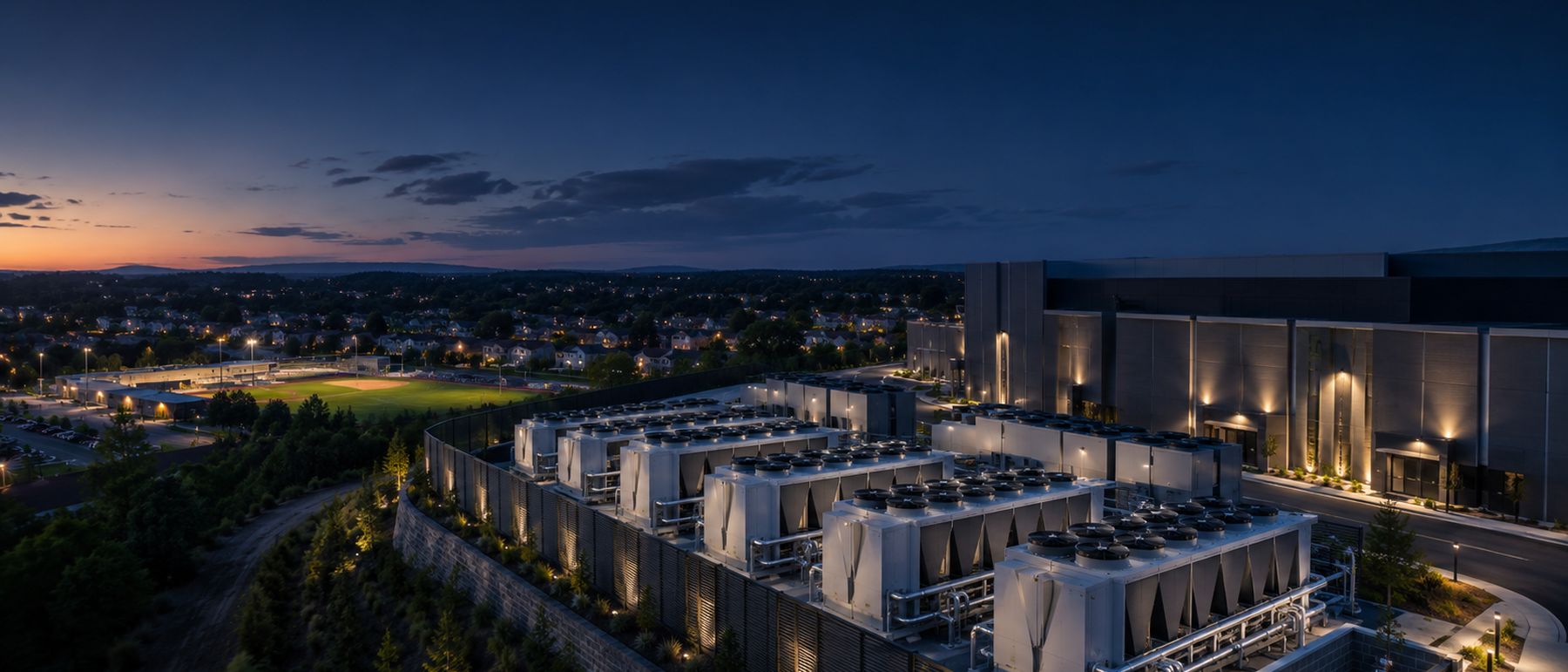
Opposition is now a scheduling risk, not a public‑relations footnote. Water draw, grid impact and round‑the‑clock noise are the three objections that show up at every hearing.
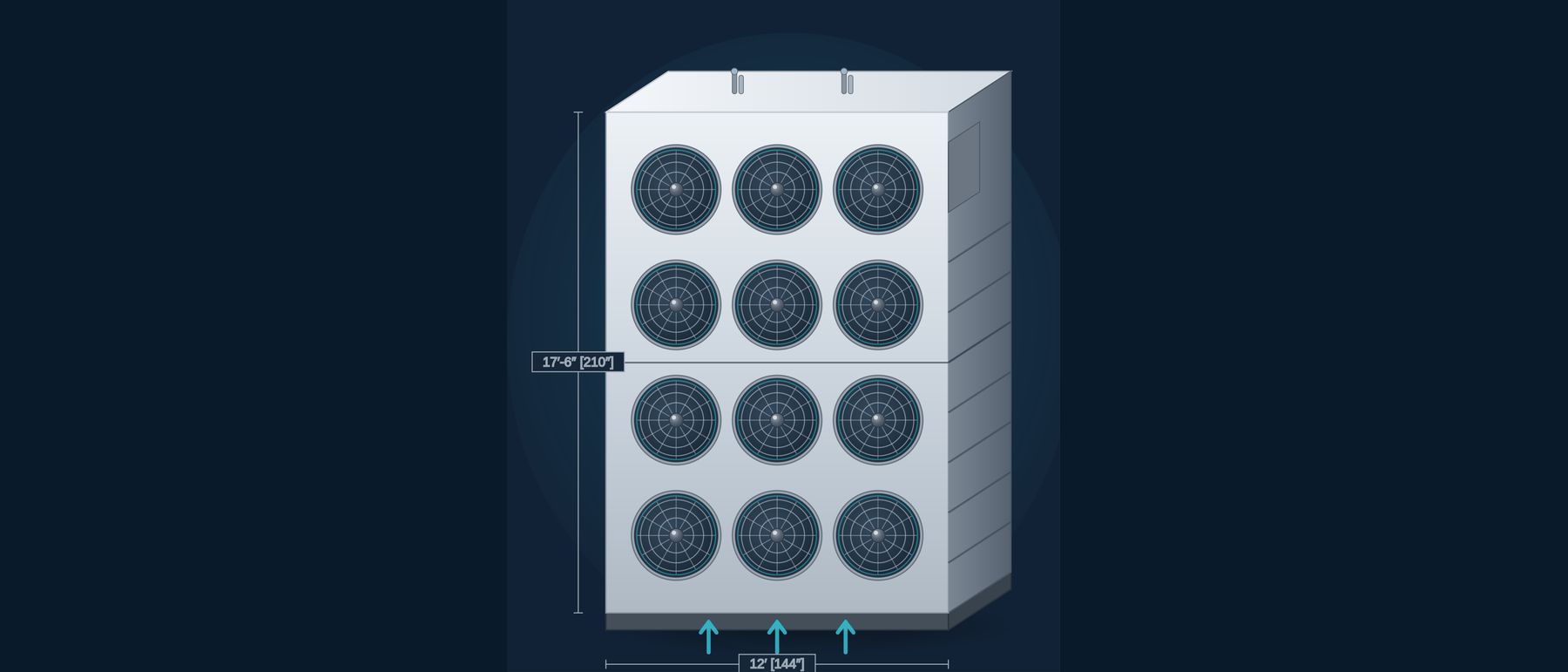
Modeled broadside for one 1 MW module in Silent Level 3. Rated: 63 dBA. Silent 3 capacity: 70% at 95°F, 81% at 80°F.
Assist runs only when you call for it — which defuses the objection that most reliably unites a hearing room.
Repeatable blocks instead of one monumental plant on the skyline.
If the burden feels local and the benefit feels distant, the project waits. HydroCore is built to shrink the burden side of that equation.
05 / Capital timing
A plant sized and purchased for full buildout commits capital before every data hall is energized. HydroCore lets the cooling investment move in phases: install the capacity needed for the first useful IT load, then release additional modules as utility power, data halls and racks are ready.
The advantage is timing. Later-phase equipment spending can remain available longer instead of sitting in idle cooling capacity. Repeatable modular additions give the owner a way to respond to actual demand while limiting the exposure to a utilization forecast that may change.
Plan the full campus. Buy cooling in useful increments.
Build the phasing plan around the next useful block of cooling, including the redundancy required at each stage. Shared infrastructure, electrical and hydronic connections, procurement lead times and commissioning must be planned so that the next module can be ready before the next load arrives.
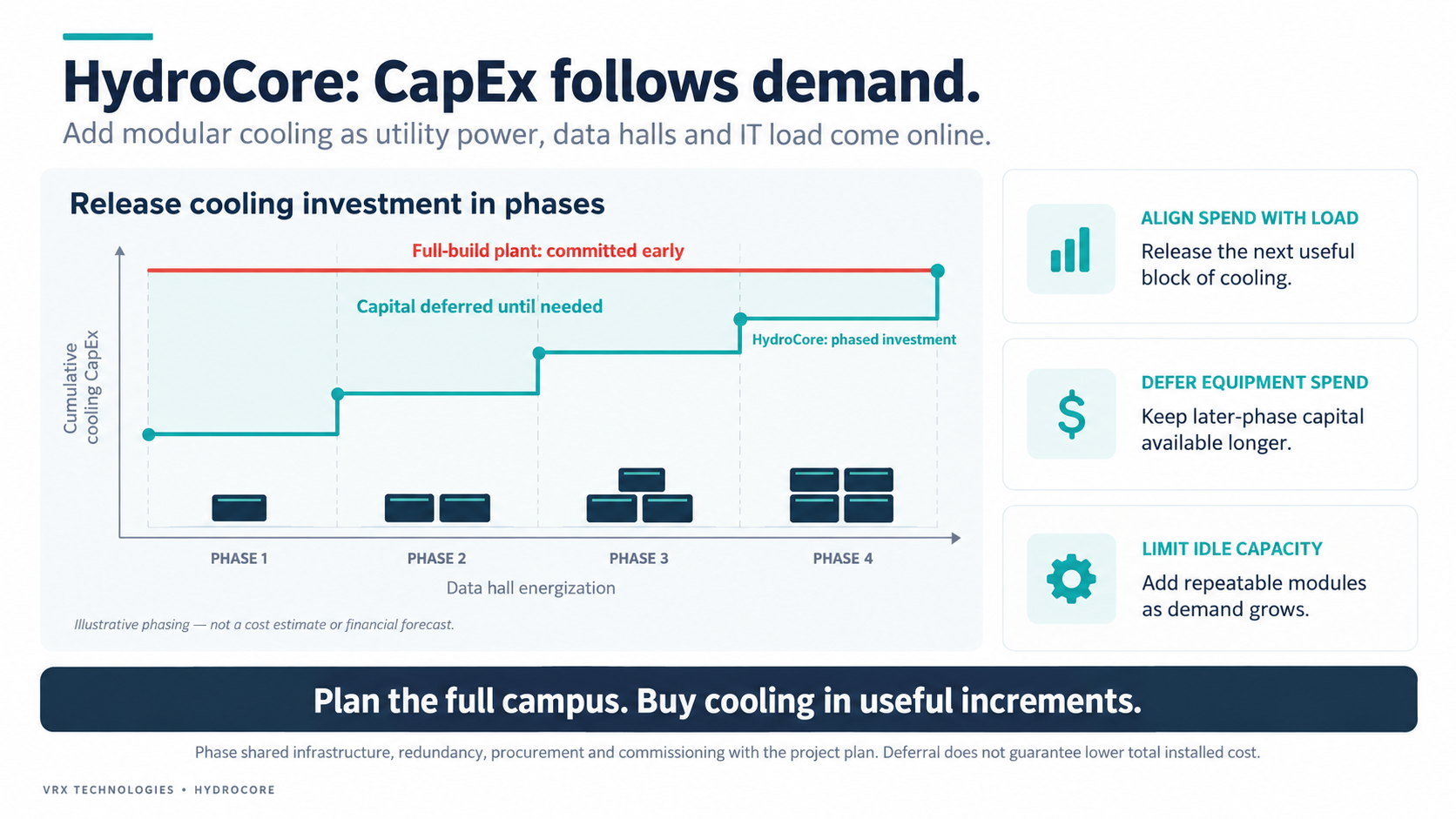
Deferring equipment purchases does not by itself guarantee a lower total installed cost. The project comparison should include shared infrastructure, redundancy, future installation work and the timing of each capacity addition.
06 / Staging resolution
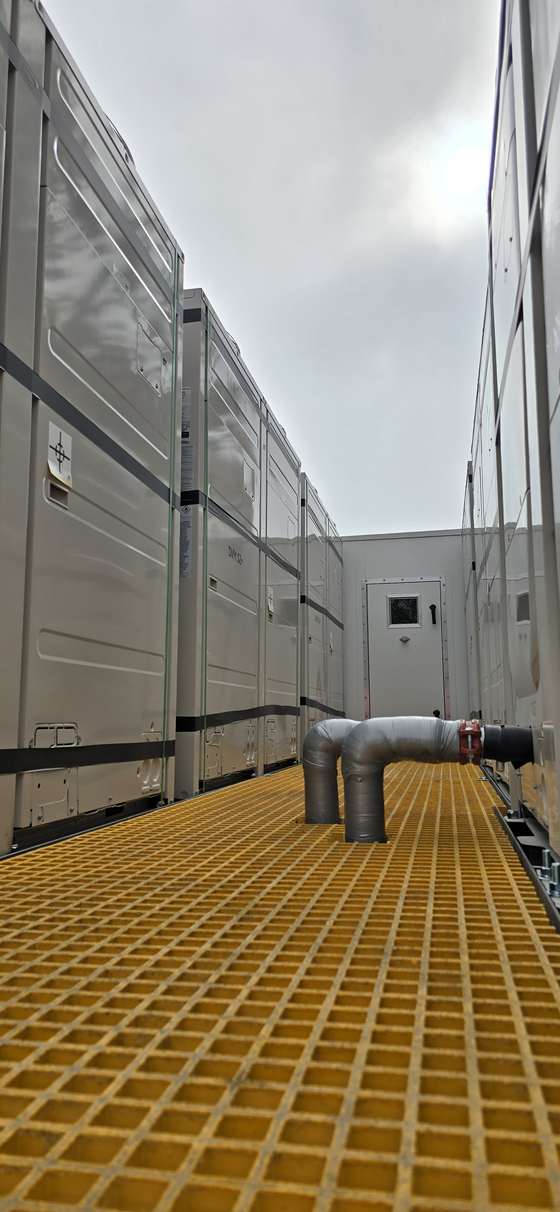
The largest part‑load exposure on most campuses is not a daily swing — it is the multi‑year buildout. What matters is how finely the plant can follow that ramp.
Illustrative comparison on an 18,000‑ton campus. The point is granularity: capacity that can sit close to its efficient operating zone through the ramp instead of forcing a few large machines to absorb every step.
07 / Written for the reviewer
HydroCore supports the principal U.S. data center energy‑code pathways — ASHRAE 90.1, ASHRAE 90.4 and California Title 24 computer‑room provisions.
We will not tell you a product is compliant. Adoption, amendments and local enforcement vary, and every project needs its own engineering validation and authority review. What we will do is hand your design team the analysis in the form they have to defend it in.
Send a load profile, a water restriction, a noise ordinance or a phasing plan — whatever is actually blocking it. You will hear back from someone who can read it and tell you what HydroCore does about it.