VRX HydroLoop · Whole-Building Heat Recovery
Somewhere in your building right now, one room is being cooled while another is being heated. A cooling tower throws the first one away. A boiler burns gas to make the second. HydroLoop connects them.
01 / The waste
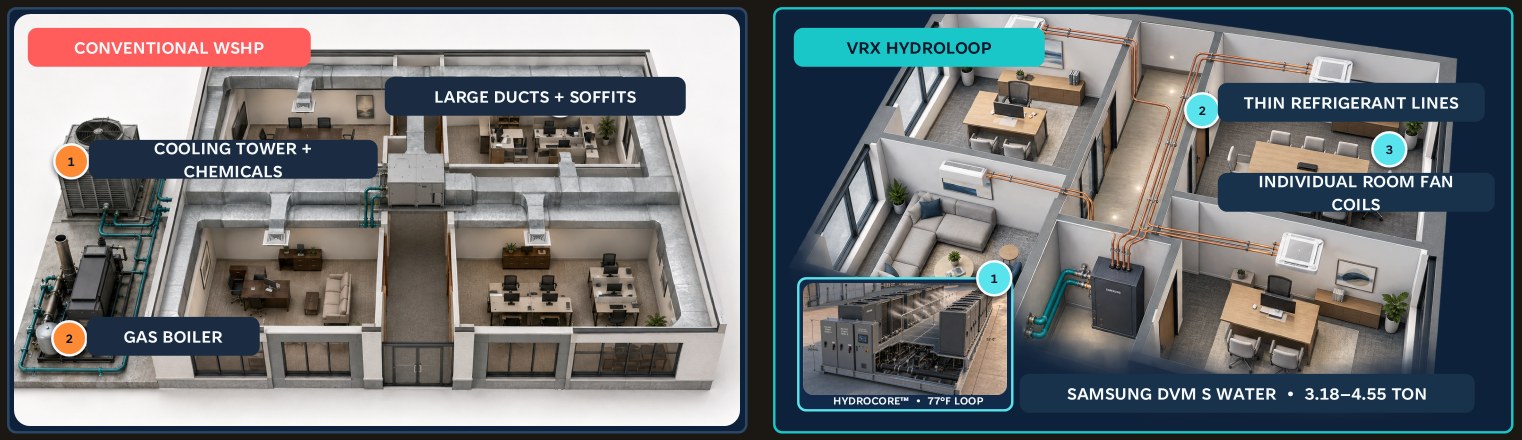
Most buildings need heating and cooling at the same time. Conventional systems reject unwanted heat through a cooling tower while a boiler burns fuel to supply heat elsewhere.
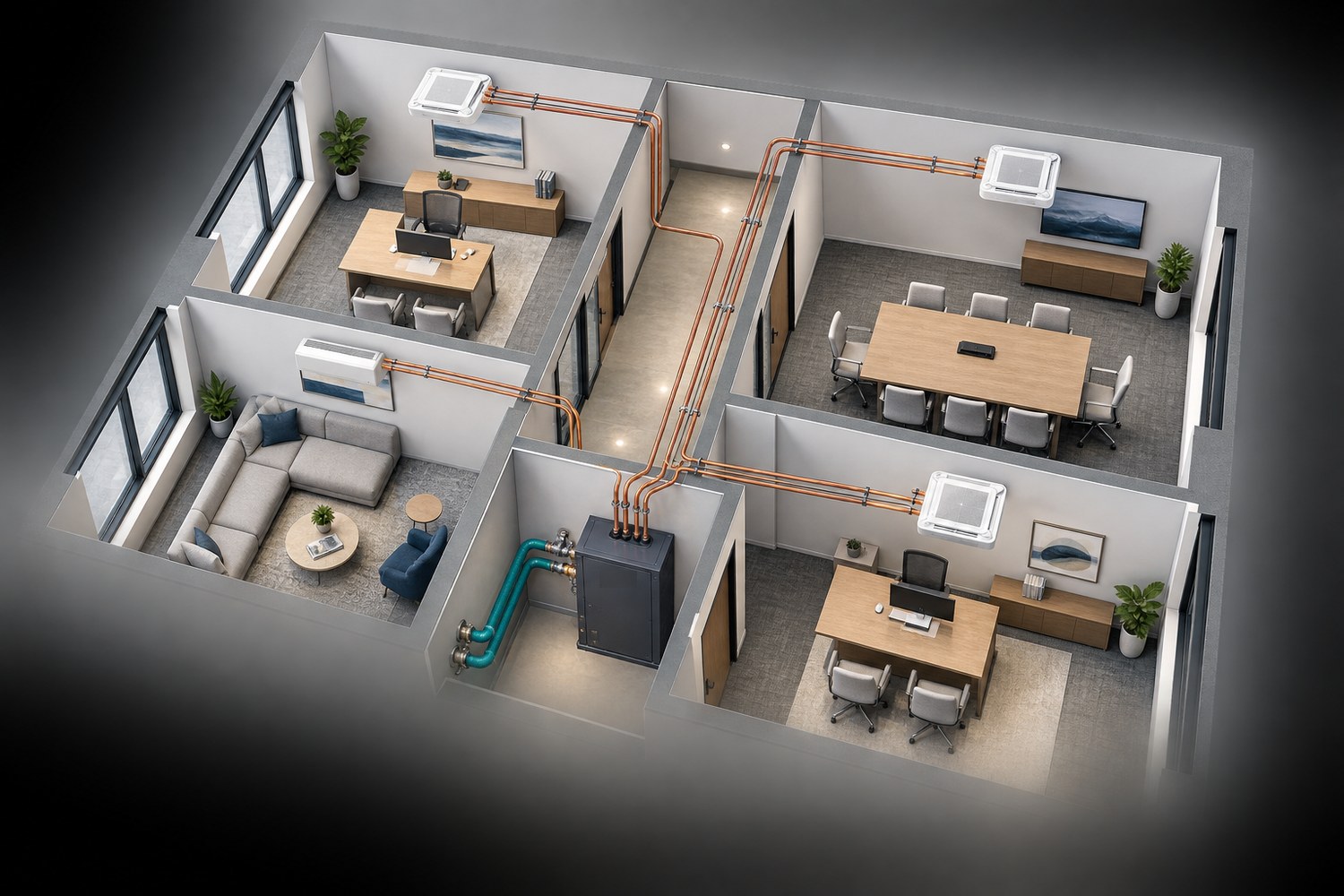
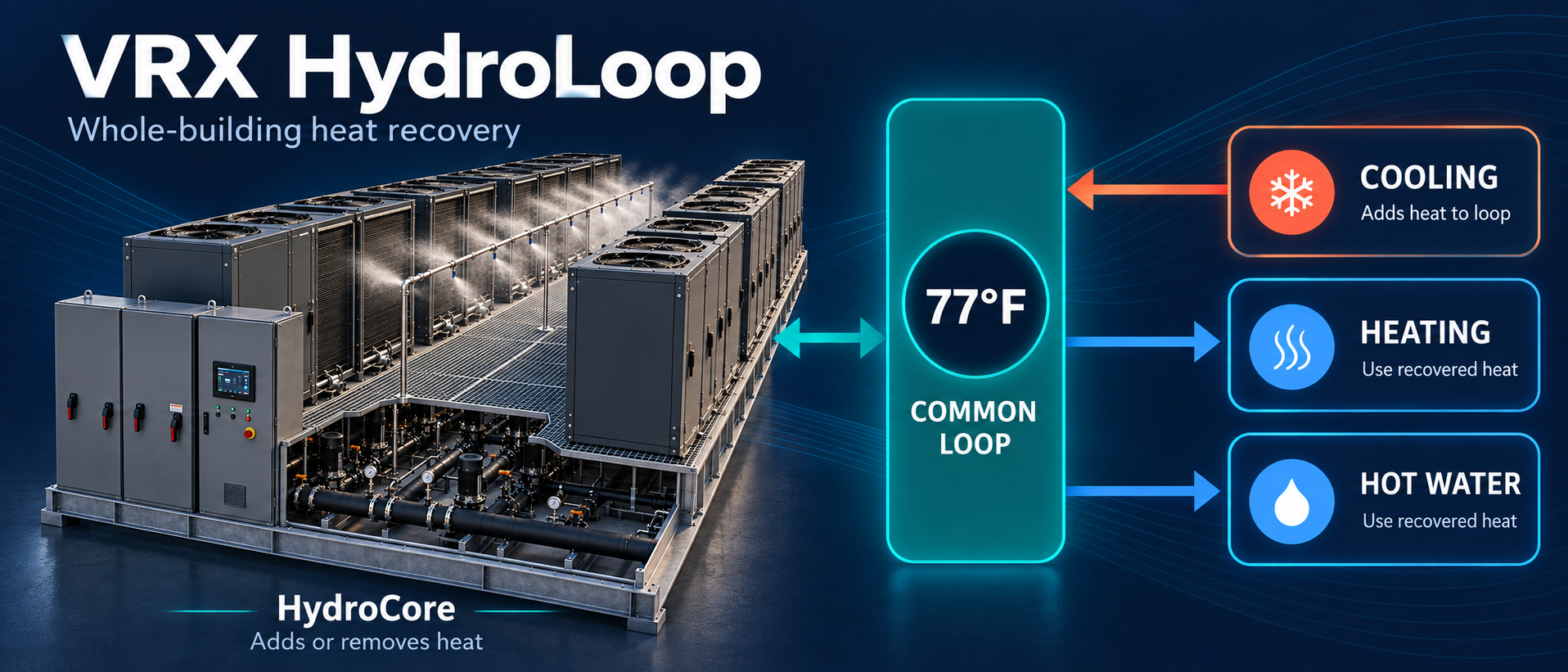
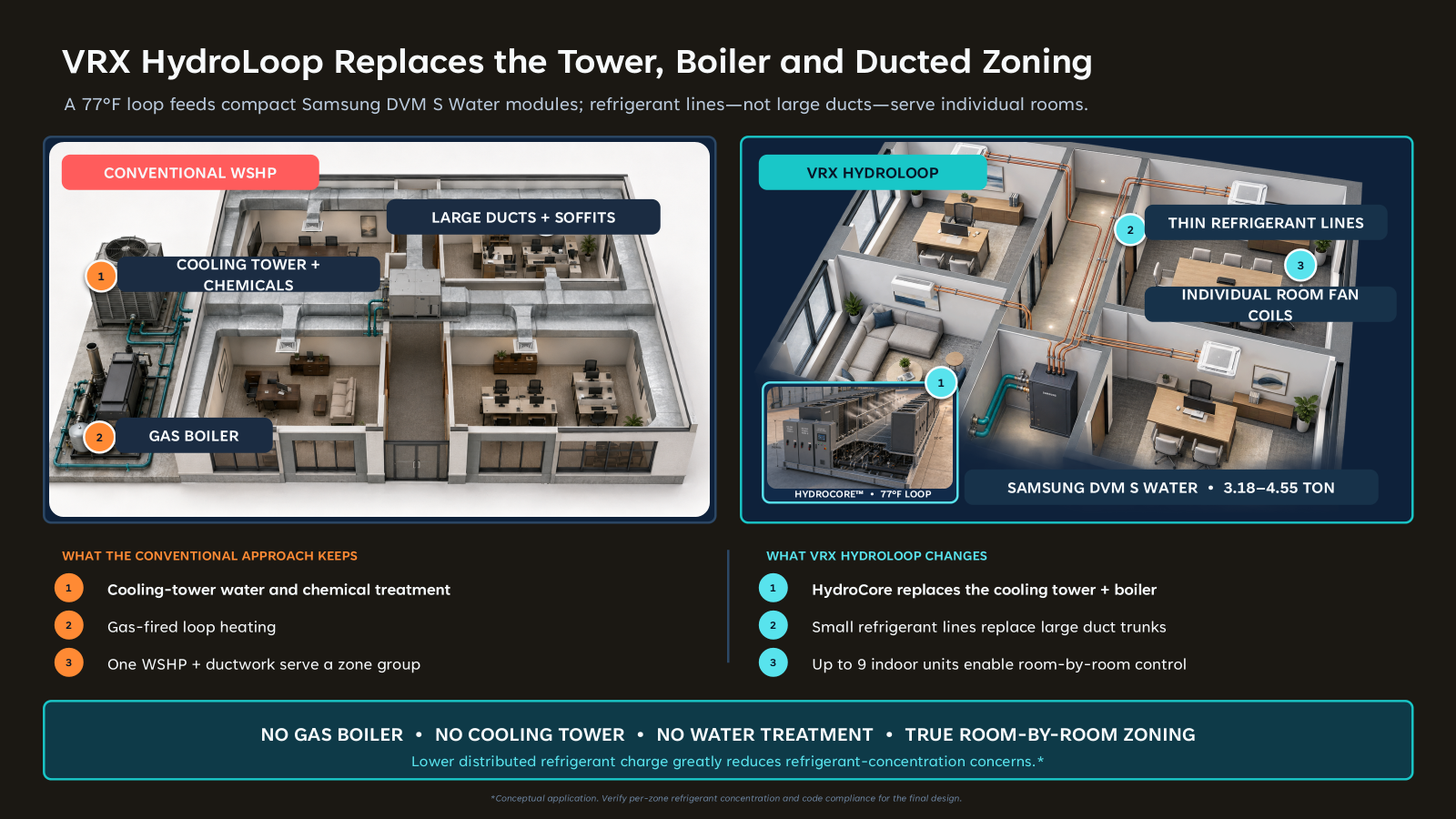
HydroLoop connects those loads through a common water loop maintained by HydroCore at a nominal 77°F. Water-source VRF heat-pump modules transfer heat between that loop and local indoor fan coils. Modules serving cooling loads add heat to the loop; modules serving heating loads draw from it. HydroCore adds or removes heat as needed to maintain the loop temperature.
Compact refrigerant lines connect each local module to individual room fan coils, providing room-level temperature control without large shared duct trunks. Simultaneous heating and cooling between rooms served by the same module depends on the selected equipment and configuration.
HydroCore manages the common loop. Local water-source VRF heat pumps and indoor fan coils deliver room-by-room comfort.
The module configuration described here has a factory charge of 2.4 lb of R-32, an A2L refrigerant, per water-source VRF module. This is the factory charge, not the total installed system charge; any field-added refrigerant required for piping and connected equipment must also be included.
Keeping refrigerant circuits local can reduce the charge associated with each occupied area compared with a larger interconnected VRF system, helping manage A2L concentration concerns. The factory charge alone does not establish compliance. Final verification must account for the installed and releasable refrigerant charge, piping, room size, equipment-specific mitigation requirements, and applicable codes.
02 / What leaves the building
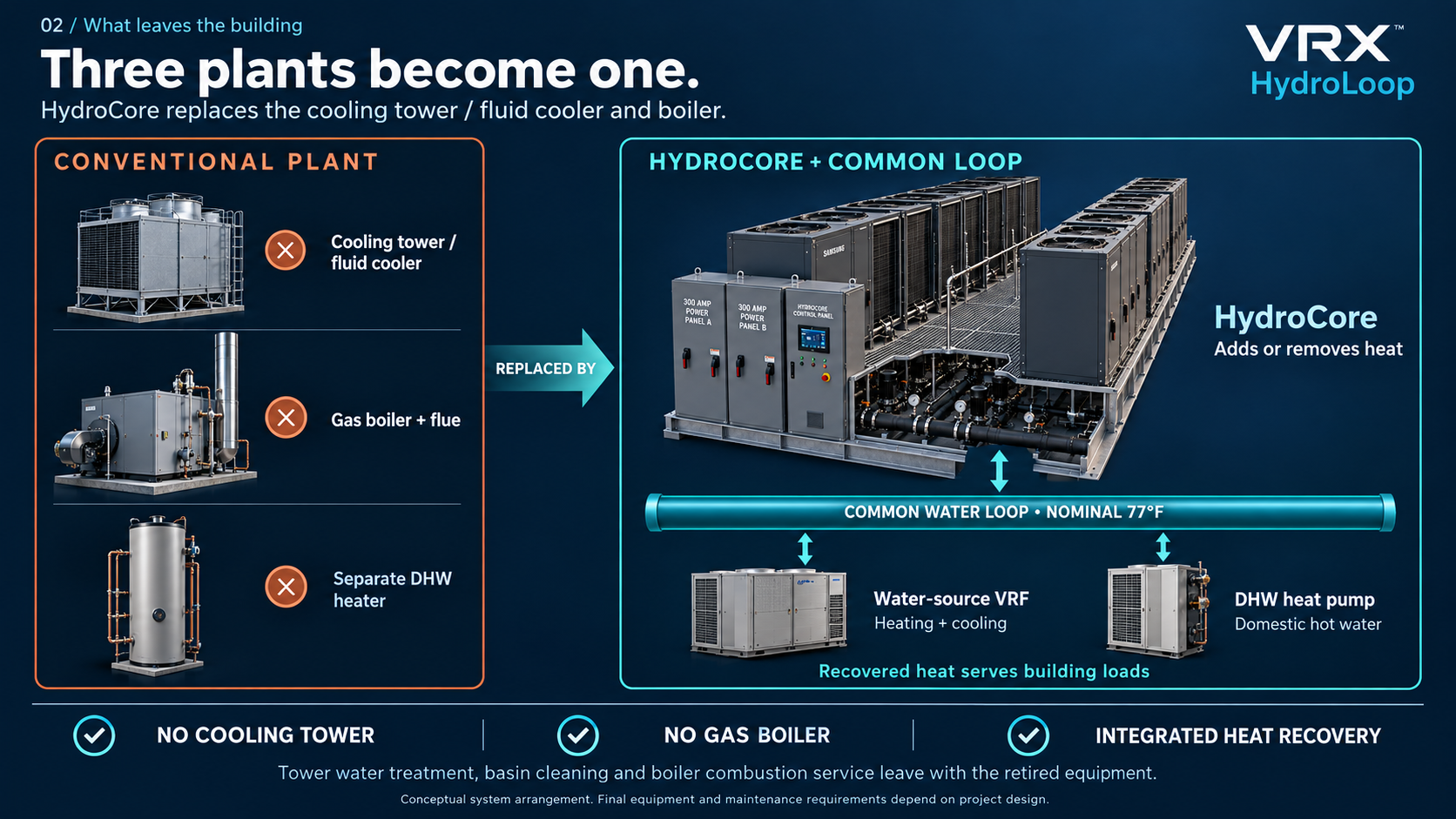
The cooling tower goes, and its water treatment program, chemical deliveries, basin cleaning and seasonal service go with it. The gas boiler goes, and so does its flue, its gas service and its combustion inspections.
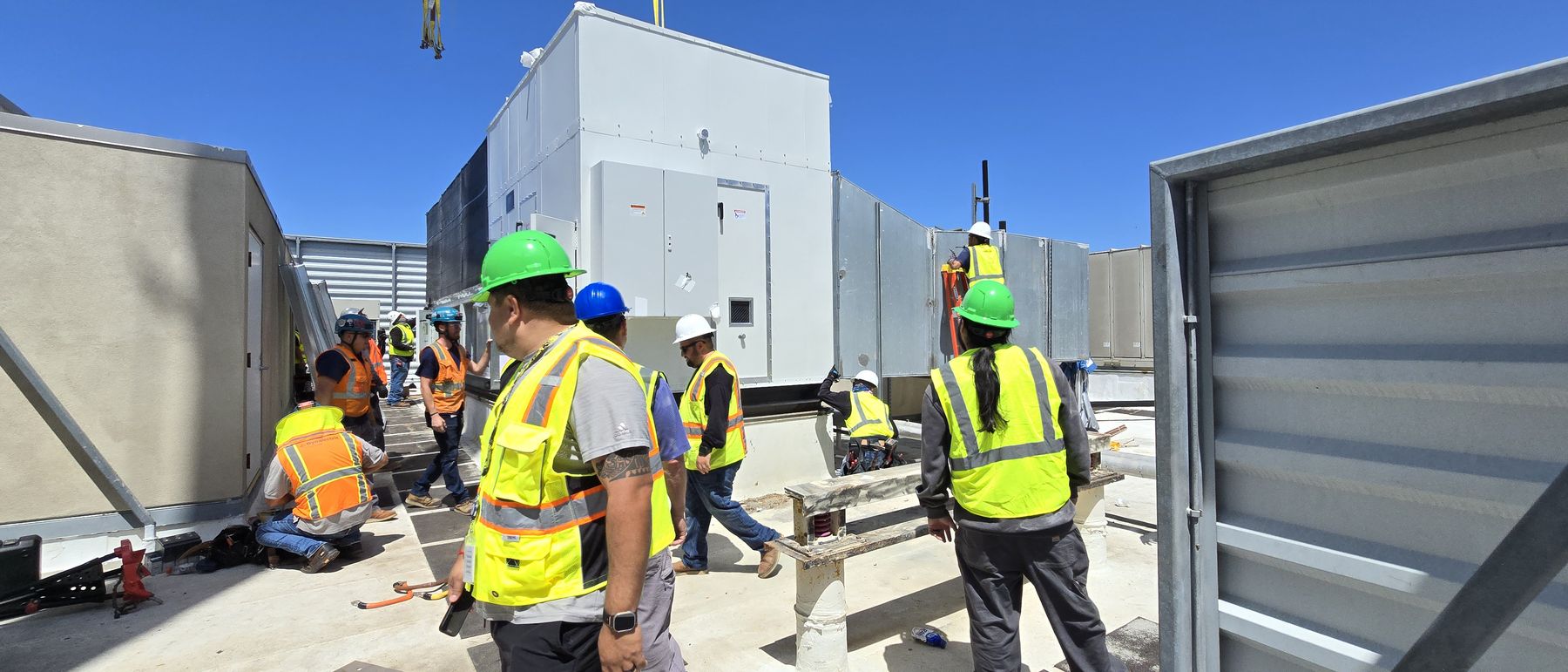
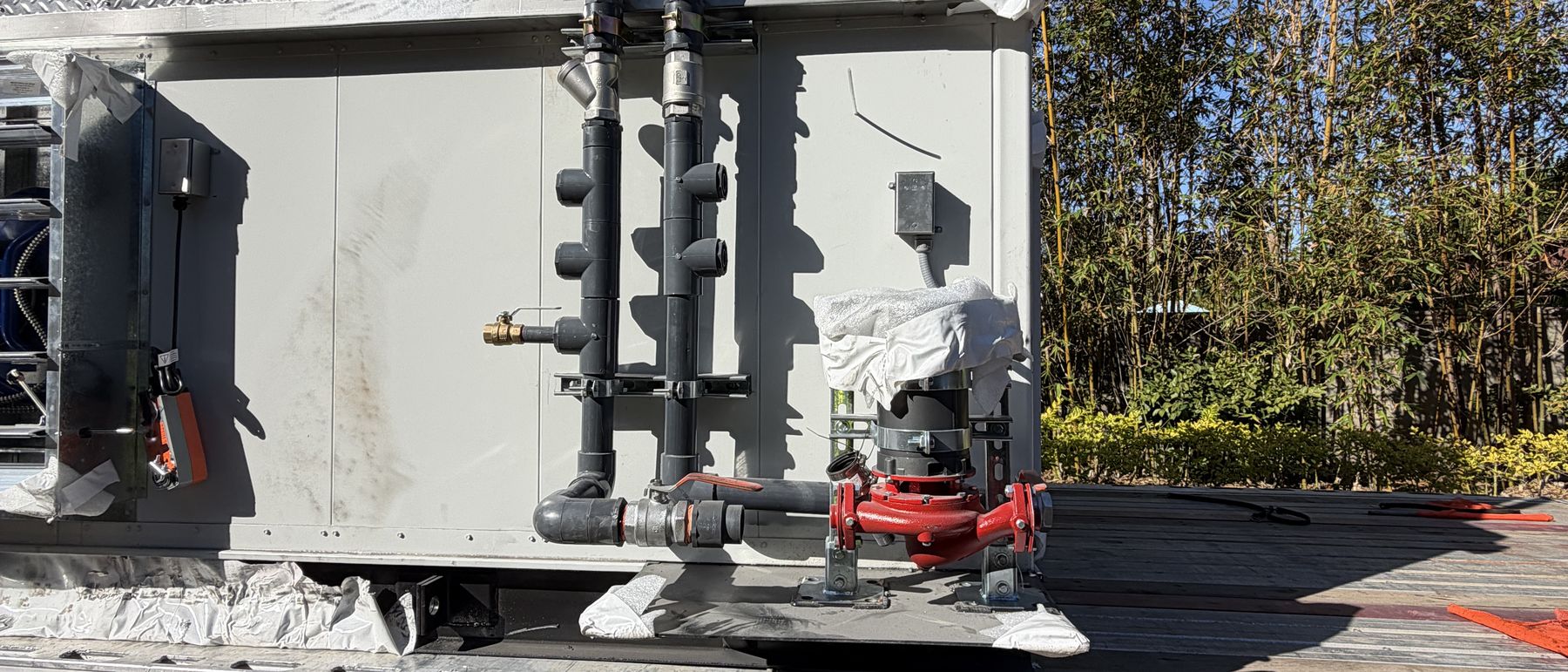
What replaces them is a single loop and a modular plant — the same platform behind our data center work. The mechanical room gets smaller, the roof gets quieter, and the annual maintenance list gets materially shorter.
03 / Domestic hot water
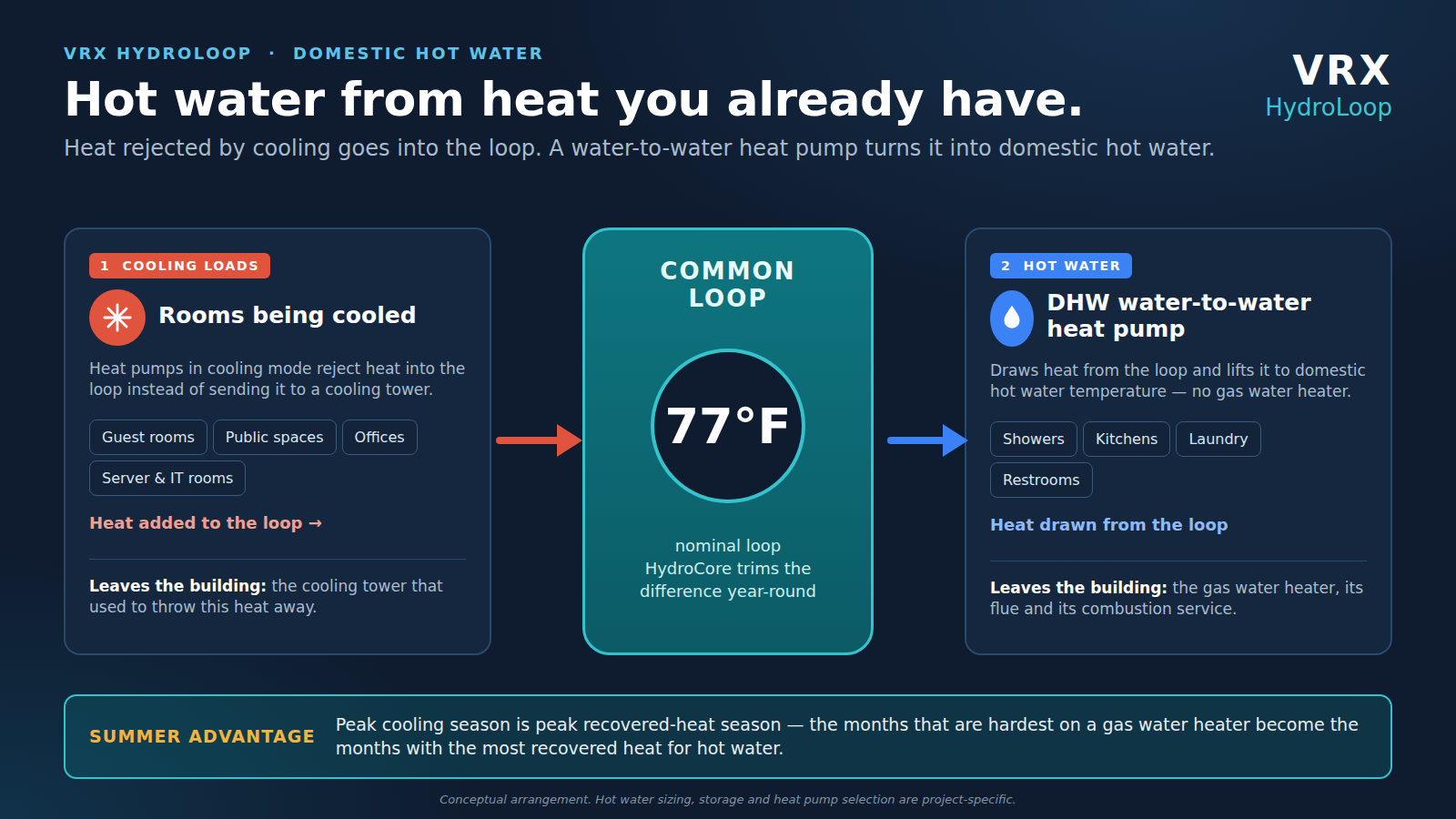
Domestic hot water is normally a standalone cost — a heater, a fuel bill, and a load that runs hardest in the morning when the building is also starting to cool. On HydroLoop it becomes a use for heat the building is already producing.
In a hotel, that means guest showers running on heat recovered from the rooms and public spaces being cooled. In an office or a school, it is the same trade at a different scale. The summer months — usually the worst case for a gas water heater — become the months with the most surplus heat available.
One more combustion appliance, service contract and utility account off the building.
Peak cooling season is peak recovered-heat season. The loads work with each other instead of against each other.
Hot water comes off the loop that is already there, not from another room full of equipment.
04 / Control
Conventional water source heat pump layouts put one unit and one duct system in charge of a group of rooms. Everyone in that group shares a thermostat, and somebody is always unhappy.
HydroLoop serves individual rooms. The corner office and the interior conference room can be in opposite modes at the same time, on the same loop, without an argument at the front desk or a work order every Monday.
05 / Space and ceilings
Large duct trunks and the soffits that hide them are one of the most expensive things about a retrofit — they eat ceiling height, they need shafts, and they force you to open more of the building than you wanted to.
HydroLoop distributes with compact lines instead. In an occupied renovation that can be the difference between a floor you can phase around tenants and a floor you have to empty.
Less soffit and shaft to build around, which matters most in buildings that never had much to give.
Less refrigerant spread through occupied space — a question that gets asked earlier in every review cycle now.
06 / Where it fits
Guest-room control that actually works, and hot water from heat the building is already rejecting.
Individual comfort control per unit, with the gas service and the tower taken off the property.
Perimeter and interior in opposite modes on the same day, which is most days of the year.
Aging tower-and-boiler plants at end of life, in buildings that cannot be emptied to do the work.
07 / Written for the reviewer
Every HydroLoop is selected on the building it is going into — its loads, its simultaneity, its hot water profile and what is physically left of its mechanical space. We hand your design team the analysis in the form they have to defend it in.
We will not tell you a product is code‑compliant. Adoption, amendments and local enforcement vary, and every project needs its own engineering validation and authority review.
A tower, a boiler, a water heater and a comfort complaint list. We will tell you what HydroLoop replaces, what leaves the building, and what the maintenance year looks like afterward.